Best Barrettes for Fine, Thin Hair: How to Stop Clips Sliding Out
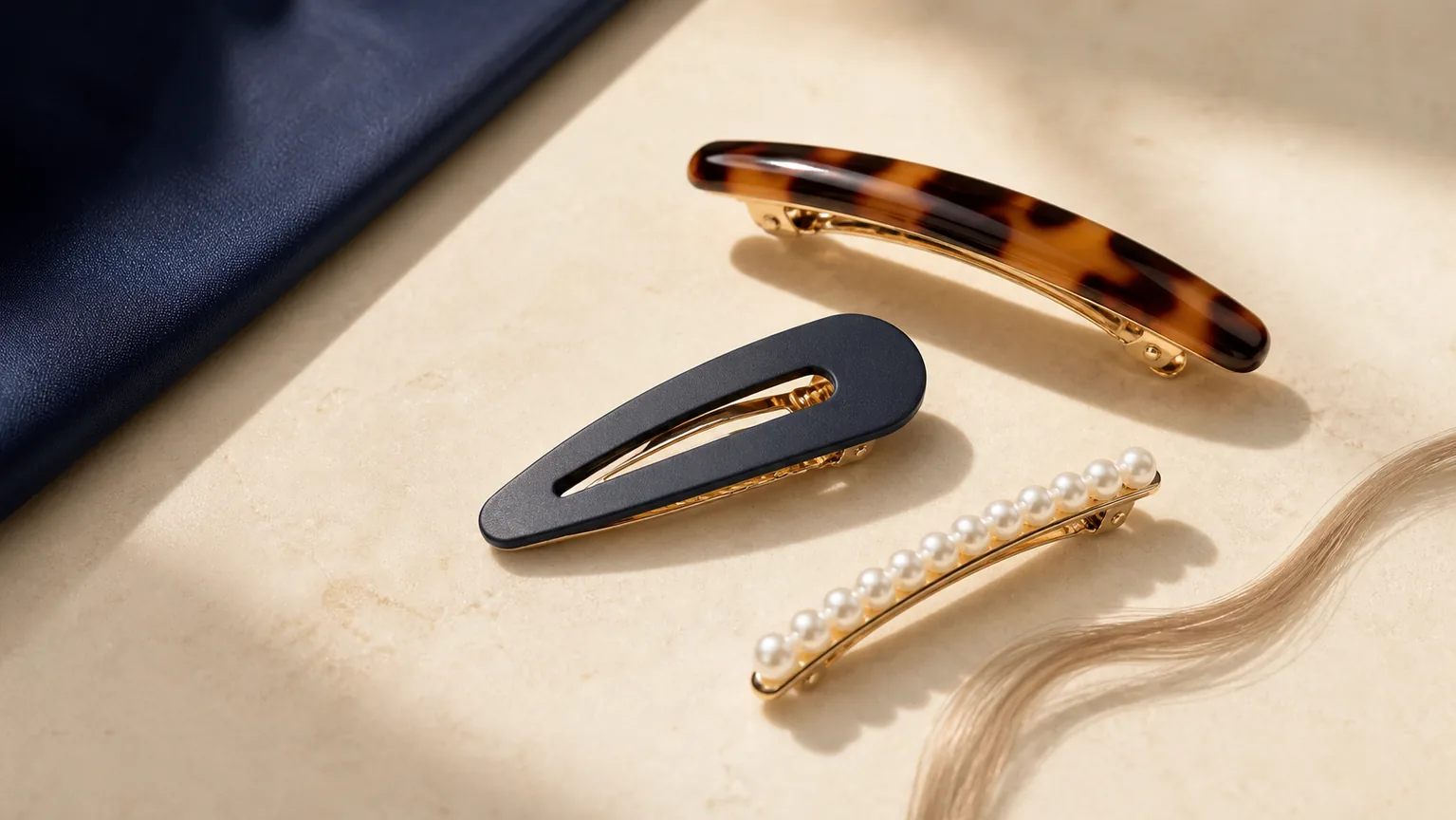
The best barrette for fine, thin or slippery hair is usually small, lightweight and sized so the closure still applies gentle pressure to the hair bundle. Look for a short French barrette or snap clip, a curved base that follows the head, smooth edges and a controlled-grip inner surface. Oversized hardware often slides because the hair does not fill its usable capacity.
Why Barrettes Slide Out of Fine Hair
Recent and long-running Reddit threads describe the same frustration: attractive barrettes close successfully, then drift down or release the hair within an hour. Suggestions repeatedly converge on small sizes, rubberized grip surfaces and clips designed for a smaller bundle. These anecdotes identify the design problem; they do not prove that one brand fits every user.
- The clasp closes before it compresses the thin hair bundle.
- The barrette is too heavy for the small area it grips.
- A straight base rocks on the curved head and slowly works loose.
- The polished inner surface has too little friction on clean, silky strands.
- The wearer asks one small clip to hold more hair than its teeth or closure can capture.
Barrette Types Compared for Fine Hair
| Type | Fine-hair advantage | Watch for |
|---|---|---|
| Small French barrette | Spring arm applies controlled pressure across a defined bundle | Capacity too large or a sharp metal edge near the hinge |
| Snap clip | Thin, light and available in short sizes | Overly stiff snap action or coating that chips |
| Alligator clip | Teeth and narrow jaw can grip sections well | Exposed serrations that catch or pull strands |
| Acetate barrette | Light premium shell with smooth polished finish | Decorative shell larger than the working metal base |
| Pearl or crystal barrette | Visual volume without requiring a large hairstyle | Decoration weight and snag-prone settings |
The Four Specifications That Improve Hold
1. Match usable capacity to the actual section
Choose the hair section first. A clip for bangs or one side behind the ear needs much less capacity than a half-up style. When the barrette is closed, its spring arm or upper plate should still make light, even contact with the hair instead of leaving empty space.
2. Reduce decorative weight
Fine hair is sensitive to the ratio between accessory weight and gripping area. A short acetate shell, matte metal snap clip or restrained pearl row is more likely to stay balanced than a long, stone-heavy design on the same clasp.
3. Add friction without roughness
A molded microtexture, properly bonded soft insert or matte inner coating can reduce sliding. The grip surface must remain smooth at the edges and survive warm, humid storage without peeling. Rough metal teeth may hold temporarily but can catch fine strands during removal.
4. Follow the head curve
A curved base spreads contact along the style and reduces rocking. For a side placement, the curve and length should fit the area above or behind the ear without pressing the scalp. A miniature size is often a functional choice, not merely a children’s product aesthetic.
Buyer Decision Matrix: Turn Fit Into a Sample Specification
| Decision | Define in writing | Sample check | Evidence to keep |
|---|---|---|---|
| Use case | Hair profile, section and hairstyle | Test the intended placement on representative users | User profile, placement photos and result |
| Working fit | Base length, closed internal gap and maximum opening | Confirm contact before the closure reaches its end stop | Measured dimensions and approved sample |
| Grip & comfort | Inner surface, edge finish and acceptable shift | Timed wear test without styling product; stop for pain or pulling | Method, elapsed time, shift and comfort notes |
| Closure & decoration | Complete weight, spring action and attachment method | Cycle the closure and inspect settings, coating and alignment | Cycle count, defect photos and pass/fail record |
A No-Slip Test Without Heavy Styling Product
- Start with dry hair and the section the barrette is meant to hold.
- Close the clip and confirm that it applies light pressure before reaching the end of its travel.
- Move the head normally for 15 minutes, then mark any downward or backward shift.
- Repeat after 60 minutes and check for scalp pressure, caught strands or visible coating transfer.
- Remove the clip by fully opening the closure rather than pulling it through the hair.
Crossed hidden pins or a very small anchor section can support an occasional style, but a product marketed as no-slip should be tested on clean fine hair without relying on dry shampoo or hairspray. For larger updos, a correctly sized fine-hair claw clip may distribute grip more effectively.
Private-Label Sampling Checklist
- Record complete weight, working base length, closed internal gap and maximum opening.
- Test each size on bangs, side sections and half-up bundles rather than making one universal claim.
- Inspect metal edges, rivets, settings, glue and the underside of every decoration.
- Cycle snap and French closures, then compare pressure and alignment with an unused sample.
- Run warm-storage and wear tests on grip inserts, coatings, pearls and stone settings.
Continue the buyer decision path by comparing metal body and finish options, then put MOQ, sample and QC terms into the quote. Explore custom acetate, matte, pearl and crystal barrettes, review the quality-control framework, or send the target hair profile and dimensions through the quote form.
Frequently Asked Questions
What type of barrette is best for fine, thin hair?+
Start with a small lightweight French barrette or snap clip whose closure still contacts the hair bundle, with a curved base and smooth controlled-grip inner surface.
Why does my barrette keep sliding out?+
It may be too large or heavy, close with empty space around the hair, have a very slick inner surface or use a base shape that rocks against the head.
Do silicone or rubber grips help fine hair?+
A durable, smoothly finished grip insert can improve friction. It should be securely bonded and tested for peeling, residue, discoloration and snagging.
Are children’s barrettes good for adult fine hair?+
Their smaller working size can suit bangs and low-volume sections. Judge the closure quality, edge finish and style rather than the age label.
How can brands make a no-slip barrette claim credible?+
Define the target hair profile and hairstyle, record measurable capacity and weight, then run timed retention tests without styling products across several users.
Keep Reading
Related Articles
Start Your Project
Ready to Talk to a Factory Directly?
Free design mockup and factory-direct quote within 24 hours. Production MOQs vary by category; samples and in-stock items may be available below the custom minimum.