Best Claw Clips for Fine, Thin Hair: Why They Slip and What Actually Holds
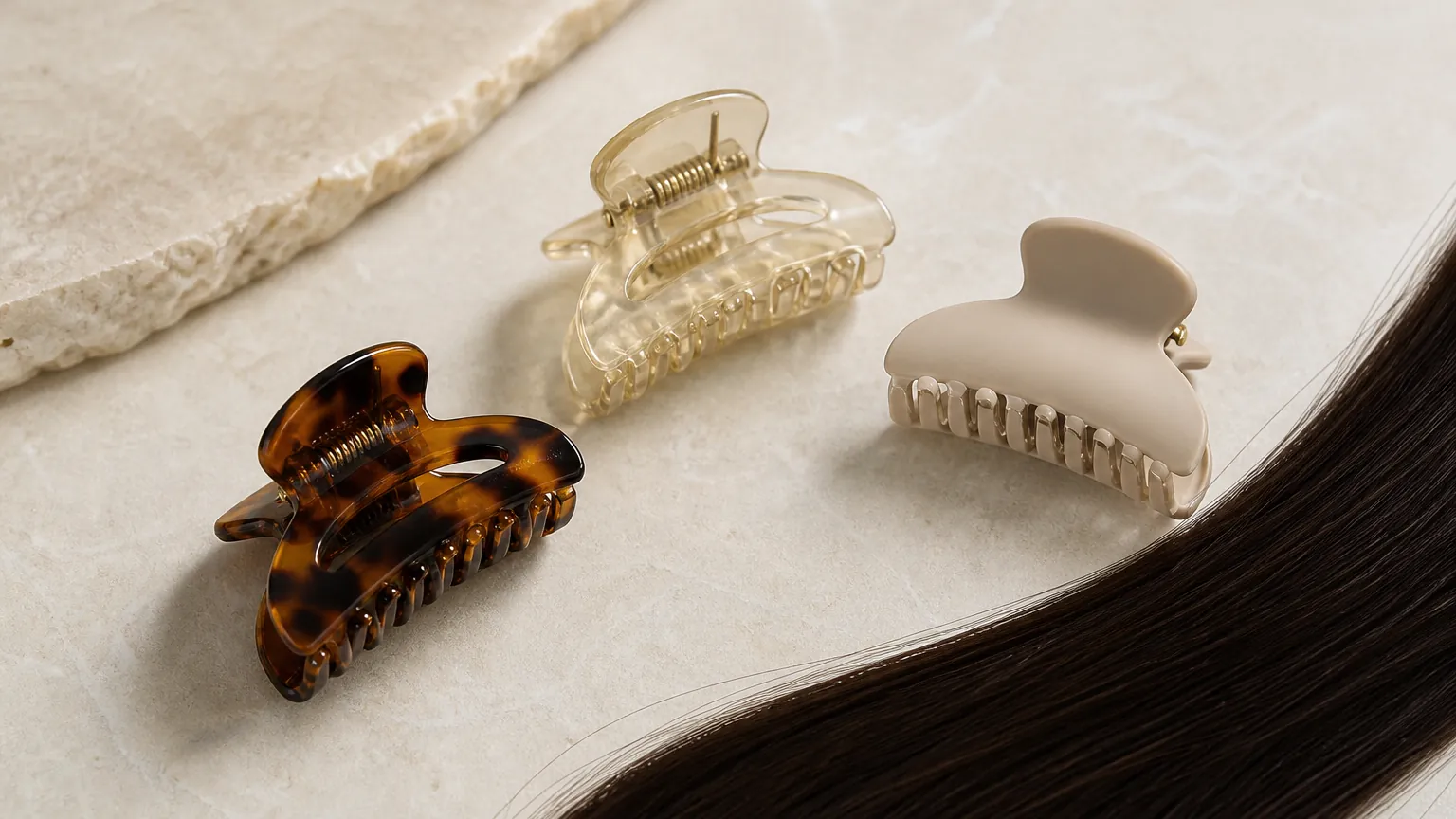
The best claw clip for fine, thin or very silky hair is usually lightweight, correctly sized and built with more contact points than a standard oversized clip. Look for a small-to-medium body, close tooth spacing, inner or double-row teeth, a balanced spring and a smooth but not glassy contact surface. A bigger or tighter clip is not automatically better: excess weight can pull the style down, while excessive spring pressure can concentrate force on a small area.
Why Claw Clips Slide Out of Fine Hair
Recent Reddit discussions repeatedly describe the same experience: a clip can look perfect yet drift downward within hours, feel too heavy, or close around the hair without actually gripping it. These are useful topic signals, not laboratory evidence, but the pattern points to four design variables that buyers can evaluate.
- The clip is larger and heavier than the hair bundle can support.
- Wide tooth spacing leaves too few contact points on a low-density bundle.
- A polished inner surface offers little friction on straight, silky strands.
- The jaw closes completely before the teeth apply useful pressure to the hair.
Hair length and hair density are separate variables. Someone can have long hair but a small ponytail circumference, so choosing only by length often produces an oversized clip. Start with the actual twisted bundle the clip must hold, then compare it with the clip's usable internal space. Our broader claw clip size guide explains the basic size categories.
The Four Specifications That Matter Most
| Feature | What usually works for fine hair | What to watch for |
|---|---|---|
| Total weight | A lightweight body proportionate to the hair bundle | Heavy decorative parts or an oversized metal spring |
| Tooth pattern | Closer spacing, inner teeth or a double row | Large gaps that let a thin bundle move |
| Usable capacity | Jaw still applies light pressure when holding the twist | Jaw closes fully with empty space around the hair |
| Contact surface | Smooth edges with a subtly grippy inner face | Sharp texture, exposed adhesive or a mirror-slick interior |
| Base shape | Curvature that follows the head without rocking | A bulky hinge or narrow pressure point against the scalp |
1. Keep weight proportional to holding area
Weight acts continuously while the spring only holds at the tooth contact points. A beautiful 11 cm clip may fail on a fine, low-volume twist even when the spring is strong. A compact acetate or engineered-plastic clip often performs better because it reduces the downward load. Decorative stones, thick cast metal and oversized hinges should be included in the finished-product weight comparison, not evaluated separately.
2. Add contact points instead of only adding tension
More closely spaced teeth, a short inner row or small interlocking teeth can distribute grip across more strands. Increasing spring force alone can create an uncomfortable pinch without solving the empty-space problem. The tooth tips must remain rounded and polished; grip should come from geometry and appropriate surface friction, not rough edges.
3. Match jaw capacity to the twisted bundle
Test the clip on the hairstyle it is meant to secure. For a French twist, the clip must capture both the folded hair and enough base hair near the scalp. For a half-up style, a smaller capacity is useful because the bundle is thinner. A multi-size collection is more credible than one clip marketed as suitable for every hair type.
4. Use controlled friction
A matte inner texture, molded micro-ridges or a properly bonded soft-touch insert can improve retention. Any insert should be tested for peeling, discoloration and hair snagging. Silicone-like parts are not automatically superior; material compatibility, edge finishing and adhesive aging determine whether the feature remains useful after repeated wear.
A Simple At-Home Fit Test
- Build the intended hairstyle without adding extra elastic bands, unless the product is specifically designed for that method.
- Check that the teeth capture hair on both sides of the twist and that the jaw is not already fully closed.
- Wear it for 30 minutes during normal movement, then check for downward drift, pressure or snagging.
- Repeat on clean silky hair and on second-day hair; the result shows how dependent the hold is on natural texture.
- Remove the clip slowly and inspect for caught strands, sharp tooth seams or a hinge that touches the scalp.
If a style needs extra hold, first change the twist direction or reduce the clip size. A small hidden elastic can anchor a style, but a product advertised as a stand-alone clip should also be tested without one. Avoid relying on heavy styling spray to make an unsuitable design pass a retention test.
Product Checklist for Brands and Wholesale Buyers
A private-label buyer should define the target hair profile before approving a sample. “For fine hair” is a testable product claim, not just a marketing phrase. Ask the manufacturer to record finished weight, clip length, maximum jaw opening, tooth count and inner tooth spacing for the approved sample.
- Run retention wear tests on at least several users with fine, straight or silky hair.
- Inspect every tooth tip and inner edge for burrs, molding flash and sharp seams.
- Cycle the hinge repeatedly and compare spring alignment before and after the test.
- Check that decorative parts and grip inserts remain bonded after warm and humid storage.
- Approve a size chart using usable capacity and target hairstyle, not length alone.
For lightweight custom options, compare cellulose acetate claw clips with engineered plastic claw clips. Buyers developing a fine-hair collection can request a design review and sample quote with their target size, weight and tooth layout.
Frequently Asked Questions
What type of claw clip is best for fine hair?+
A lightweight small-to-medium clip with close tooth spacing, inner or double-row teeth and a jaw that still applies light pressure around the twist is a strong starting point.
Why does my claw clip keep sliding down?+
The common causes are excess clip weight, a jaw that is too large for the hair bundle, too few tooth contact points or a very slick inner surface.
Are smaller claw clips always better for thin hair?+
No. The clip must still capture the intended hairstyle. Choose the smallest size that surrounds the twist with useful tooth contact and without forcing the hinge.
Do silicone grips help claw clips stay in fine hair?+
A well-designed soft grip can help, but it must have smooth edges, durable bonding and compatible materials. Tooth geometry and correct sizing still matter.
Can a manufacturer customize clips specifically for fine hair?+
Yes. Body weight, overall size, tooth spacing, inner teeth, spring selection, finish, color, logo and packaging can all be specified and verified through samples.
Keep Reading
Related Articles
Start Your Project
Ready to Talk to a Factory Directly?
Free design mockup and factory-direct quote within 24 hours. Production MOQs vary by category; samples and in-stock items may be available below the custom minimum.