Silk vs Satin Scrunchies: Which Fabric Is Better for Hair — and for Your Business?
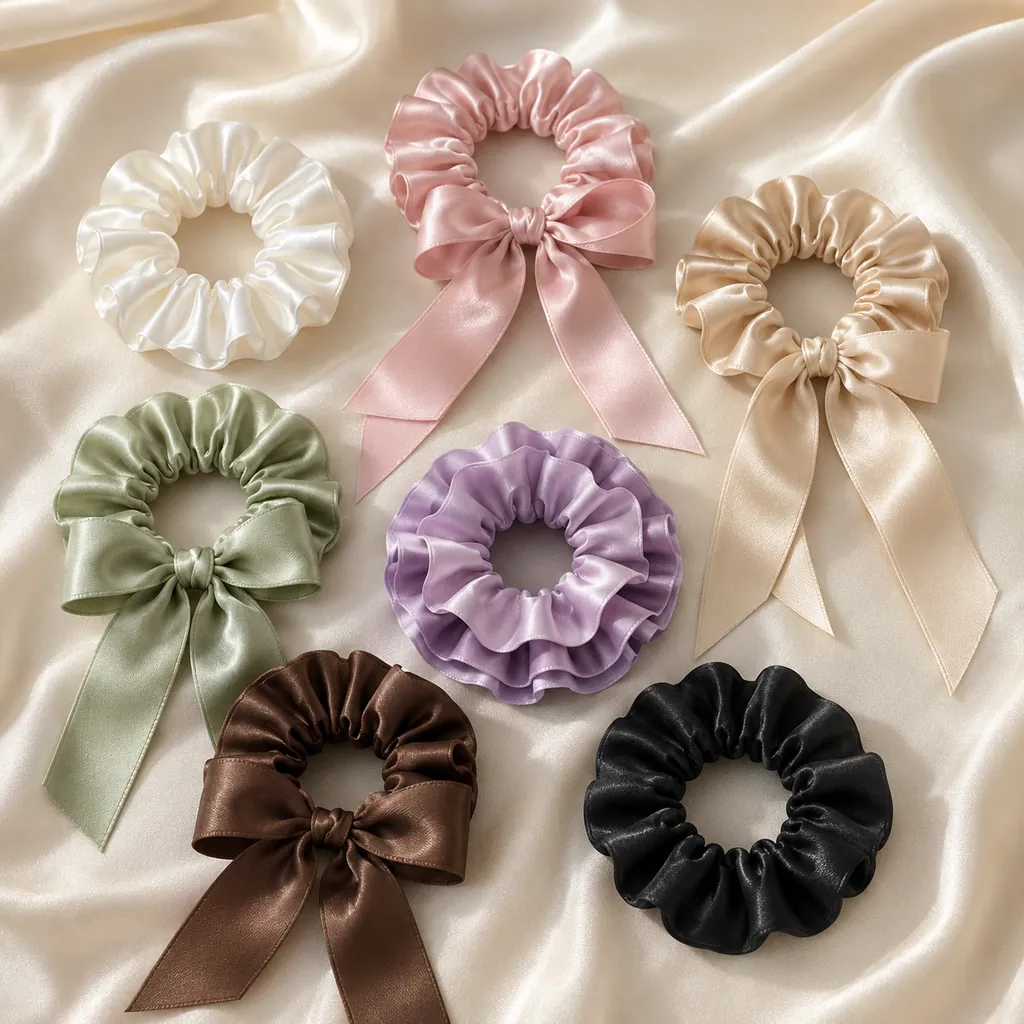
Smooth scrunchie fabrics are chosen to reduce snagging and friction compared with rougher surfaces, but “silk” and “satin” do not describe equivalent things. Silk is a fiber; satin is a weave that can use silk, polyester or another filament. For brands, compare verified fiber content, surface finish, seams, elastic tension, care and target price instead of assuming every product with either label gives the same hair result.
The Key Distinction: Fiber vs. Weave
A common misconception is that “silk” and “satin” are competing fiber names. Satin is a weave structure with longer surface floats; silk is a fiber. You can therefore buy polyester satin or silk satin. Fiber, yarn, weave, finishing and seam construction all affect the finished surface, so require both the fiber-content declaration and a physical snag/friction comparison.
Silk vs Satin: The Direct Comparison
| Factor | Mulberry Silk | Satin (Polyester) |
|---|---|---|
| Hair-contact surface | Can be very smooth; verify weave, finish and seams | Can be very smooth; verify fiber, finish and seams |
| Heat and moisture feel | Depends on silk weight, weave and construction | Depends on polyester weight, weave and construction |
| Care and wash performance | Follow the finished product care instructions; compare representative samples | Machine wash only where the finished product instructions permit it; verify the specified process |
| Quote specification | Confirm silk content, fabric weight where specified, finished dimensions, elastic, quantity and packaging. | Confirm polyester content, finished dimensions, elastic, decoration, quantity and packaging. |
| Price planning | Request a quote for the chosen specification and quantity before setting your retail price. | Request a quote for the chosen specification and quantity before setting your retail price. |
| Range positioning | Use verified fiber content and the finished product to support the description; the material name alone does not establish a selling price. | Use verified fiber content, finish and decoration to describe the product; confirm the proposed price against your own costs and market. |
What the Data and Communities Say
Hair-fiber research supports friction and abrasion as contributors to damage, but it does not establish that every silk scrunchie outperforms every polyester satin scrunchie. Community reports can help identify concerns such as snagging, slippage and heat, yet they are not controlled product tests. Compare representative samples on the same hair bundle and record surface snags, elastic force, seam exposure and wash performance.
Which Should Your Brand Stock?
- Consider silk when verified silk content, the finished dimensions and the product's care requirements suit your range. Compare representative samples and a quote for the chosen specification before deciding quantities.
- Consider polyester satin when its finish, construction and decoration suit the range. Follow the finished product's care instructions; the fabric name alone does not establish machine washability.
- Compare both when you want to evaluate distinct material or decorative directions. Keep the fiber declaration, dimensions, care instructions and order terms separate for each style before building an assortment.
If two wraps slip but three feel uncomfortable, fabric choice is only part of the question. Our scrunchie fit, size and elastic guide explains how to compare loop size, resistance and recovery, with a sample record for brands.
What to Specify When Ordering Scrunchies Wholesale
- Fiber and fabric: identify the selected style and its declared fiber content. Record fabric weight where it is specified; do not infer a grade from the words "mulberry silk."
- Finished dimensions: record the listed width and outer diameter for the exact option. Sizes vary by style; do not use one diameter for every scrunchie.
- Elastic and fit: record the intended hairstyle and hair volume, then compare hold and comfort on representative samples.
- Construction and care: inspect the casing, seams and decoration, and use the finished accessory's stated care instructions when planning sample checks.
- Labeling and packaging: describe any requirements in the brief and ask which options and terms are available for the selected style.
- Supporting evidence: identify the exact product or material covered by any proposed certification or test claim and request the relevant current documentation.
Sizes belong to the individual style. The listed Mulberry Silk Scrunchie pairs widths of 2, 4, 6 and 8 cm with approximate outer diameters of 6, 8, 12 and 16 cm respectively. The Rhinestone Satin Scrunchie is 100% polyester satin, with an approximate outer diameter of 12–14 cm and hot-fix rhinestone decoration. Follow its gentle cold hand-wash instructions and avoid machine washing or tumble drying.
Compare the selected silk, polyester satin and fabric options in our scrunchie collection. Production MOQ is 1,500 pieces for all listed scrunchies, including selected styles. Samples and in-stock items can be discussed separately. Share the selected style, size, preferred colors, quantity and destination so availability and delivery timing can be confirmed.
Frequently Asked Questions
Are satin scrunchies as good as silk for hair?+
The label alone cannot answer that. Compare fiber content, weave, finish, seams and elastic tension. A smooth, well-finished polyester satin product may outperform a rough or poorly sewn silk product in a specific use.
Is silk or satin better for sleeping?+
Satin is a weave, so first identify the fiber. Heat, moisture and friction depend on fabric weight, construction and finish; avoid claiming that all silk sleeps cooler or that both materials prevent breakage equally without product-specific testing.
Why are silk scrunchies so expensive?+
Verified silk fiber, fabric weight, finishing, sewing, waste rate and order volume can raise cost relative to common polyester satin. Ask for fiber content and momme or fabric-weight specifications rather than relying on “6A” or “mulberry” wording alone.
Do silk scrunchies slip out of hair?+
Silk can lack traction on very heavy or slippery hair, especially for high ponytails. If traction is an issue, choose a tighter satin weave or a silk scrunchie with a slightly textured outer layer.
Ready to compare options for your range? Request a sample and quote with your selected style, preferred size and color, quantity and destination. Ask for sample availability, charges, shipping and lead time to be confirmed before ordering.
Keep Reading
Related Articles
Start Your Project
Ready to Talk to a Factory Directly?
Free design mockup and factory-direct quote within 24 hours. Production MOQs vary by category; samples and in-stock items may be available below the custom minimum.