Why Headbands Hurt or Slip Off: A Comfort and Fit Guide
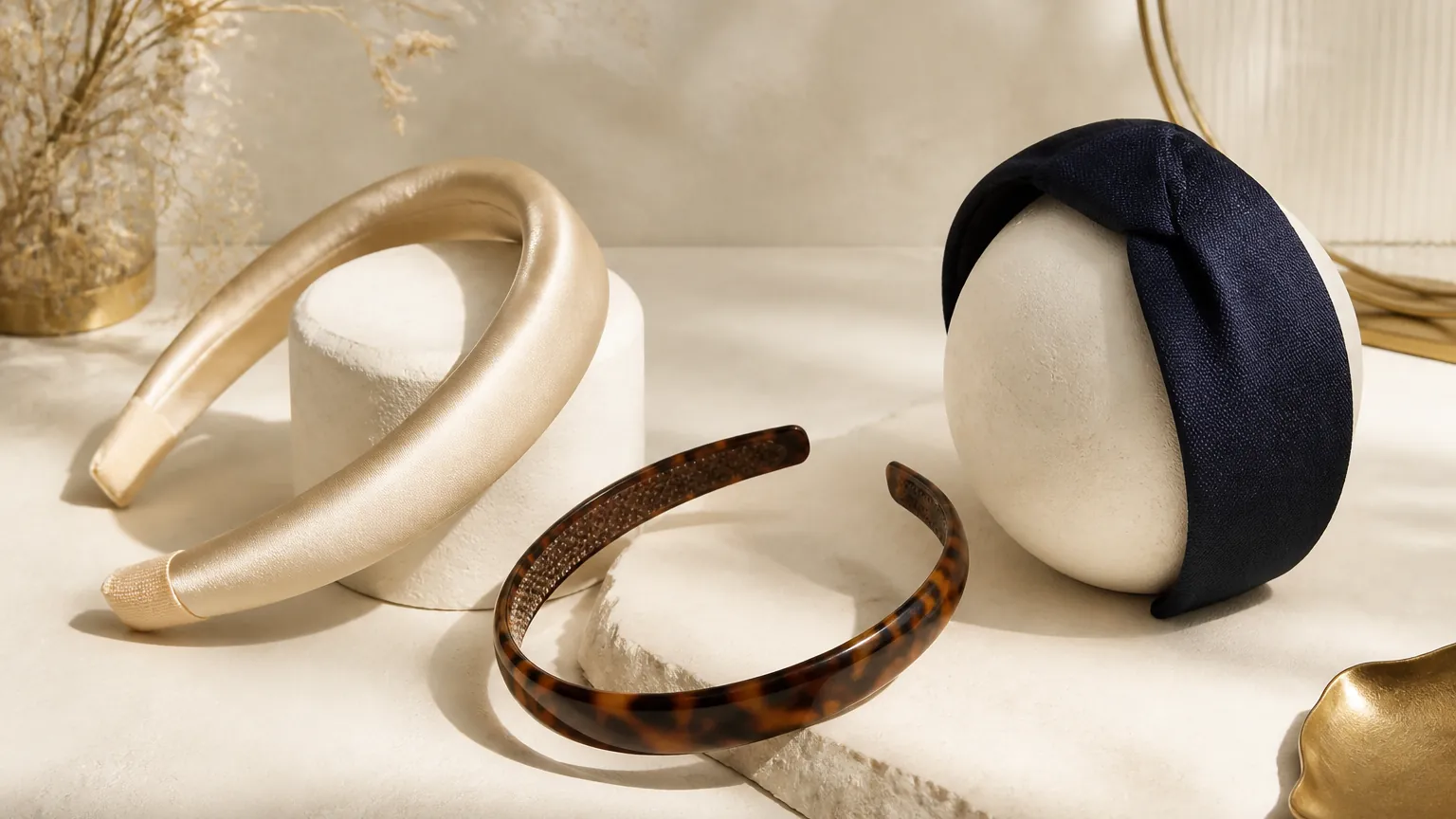
Headbands usually hurt because a stiff or narrow band concentrates pressure at the ends, often behind the ears. They usually slip because the shape does not match the head, the band is too loose, or the underside has too little friction. Solving one problem can worsen the other, so a comfortable headband needs balanced curvature, distributed pressure, low weight and controlled grip—not simply a tighter band.
The Two Problems Need Different Fixes
Across Reddit beauty and fashion communities, discussions about headbands recur for years: some users remove a rigid band because the ends ache, while others cannot keep a fabric band from moving backward. Community reports are valuable for discovering product problems, but they are not medical studies. The cited dermatology guidance addresses tight hairstyles and repeated pulling—not headband product testing—and treats pain as a warning that the style is too tight. If a headband causes persistent or severe pain, remove it rather than keep tightening or adjusting it.
| Symptom | Likely design cause | Better direction |
|---|---|---|
| Pain behind the ears | High end pressure, hard tips or narrow contact area | Softer tips, wider contact and a more open curve |
| Headache across the sides | Overall band tension is too high | More flexible core or a size with greater internal width |
| Band slides backward | Low friction or curvature does not follow the head | Textured underside, better contour or discreet comb teeth |
| Fabric band rolls or creeps | Band is too narrow, too loose or unevenly stretched | Wider construction, stable elastic and flatter seams |
| Band rocks on the crown | Heavy decoration or rigid shape creates a high center of mass | Lower weight and more even structure |
Why Rigid Headbands Hurt Behind the Ears
A rigid band works like a spring: spreading it creates inward force. If most of that force reaches the head through two small end points, local pressure rises. Narrow cores and thin uncovered tips can therefore feel worse than a wider padded design, even when the total clamping force is similar.
- End position: tips should not sit directly on a sensitive ear joint or sharp bony area.
- Tip area: a wider, rounded and softly covered end distributes pressure.
- Core flexibility: a band that opens gradually can adapt to more head widths.
- Weight balance: tall knots, pearls and stones should not pull the band toward one pressure point.
- Seam finish: folded fabric, glue edges and decorative wire should remain outside the skin-contact zone.
Padding helps only when it is placed over a well-shaped core. A very tight metal or plastic core wrapped in thick foam can still produce pressure, and bulky padding may move the contact point rather than reduce it. For material and construction comparisons, see velvet vs cotton vs silk headbands.
Why Fabric and Stretch Headbands Slip
A fabric loop stays in place when elastic recovery, underside friction, width and head contour are in balance. Very smooth satin on smooth straight hair offers little friction; a narrow band may roll; an overstretched band moves toward the narrowest part of the head; and a loose band has no normal force to create grip.
- Choose a wider band when narrow elastic rolls or migrates backward.
- Use a textured or velvet underside while keeping the visible face smooth.
- Keep the seam flat and position it where it will not create a pressure ridge.
- Offer more than one circumference when the elastic range cannot fit the target market comfortably.
- For occasional extra security, use small hidden pins or a discreet inner comb instead of making the whole band tighter.
Headband Types Compared
| Construction | Comfort advantage | Grip consideration |
|---|---|---|
| Padded rigid band | Wide contact area and protected edges | Core curve still needs to match multiple head widths |
| Flexible acetate band | Low bulk and adjustable-feeling flex | Smooth underside may need texture or small teeth |
| Knotted fabric band | Soft visual volume without a heavy frame | Knot weight and inner core can shift pressure |
| Elastic fabric loop | No hard ends behind the ears | Elastic recovery, width and surface friction control slip |
| Tie headband | User adjusts circumference | Knot and fabric surface determine long-wear stability |
A 30-Minute Comfort and Retention Test
- Wear the headband in its intended position without pins or styling products for the first test.
- After five minutes, note pressure at both ends, the temples, crown and any seam contact.
- Walk, look down and turn the head normally; mark how far the band moves after 15 and 30 minutes.
- Repeat with hair down and with the target updo because volume and surface texture change the fit.
- Remove the band and check for skin marks, pulled strands, caught hair or exposed hard edges.
Minor repositioning can change the pressure point, but a band that quickly causes pain is not an all-day fit. Do not repeatedly stretch a molded band unless the manufacturer says the core is designed for adjustment; uncontrolled bending can crack the core or permanently change symmetry.
Design Checklist for Private-Label Buyers
Headband fit varies with head width, head shape, hairstyle and sensory preference. A brand should test samples across a small fit panel instead of approving them on one person. Define the intended use—fashion statement, daily work, sport or event wear—before selecting the core and lining.
- Record internal width, arc shape, finished weight and end-to-end opening on the golden sample.
- Inspect end caps, seams, glue, wire and ornament attachments in every skin-contact area.
- Test at several head widths for both pressure and backward movement.
- Check elastic recovery or core symmetry after repeated wear and warm storage.
- Use claim language such as “soft padded ends” only when the production inspection can verify it.
Compare custom padded headbands, braided headbands and satin headbands for different comfort and grip directions. Brands can request a fit-focused sample consultation with target dimensions, fabric and decoration requirements.
Frequently Asked Questions
Why do headbands hurt behind my ears?+
The band ends may concentrate too much pressure on a small area. A wider curve, softer rounded tips, lower tension and lighter decoration can improve comfort.
How do I keep a headband from slipping backward?+
Look for a shape that follows the head, a wider contact area and a subtly textured underside. Small hidden pins or inner comb teeth can add localized grip.
Are padded headbands more comfortable?+
They can distribute contact and cover hard edges, but padding cannot compensate for a core that is too narrow or too tight for the wearer.
Why do elastic fabric headbands roll up?+
The band may be too narrow, unevenly stretched, overly loose or made with seams and layers that do not lie flat.
Can a headband manufacturer make multiple fits?+
Yes. A collection can vary core width, curvature, end treatment, elastic circumference, lining, padding and weight for different use cases and target customers.
Keep Reading
Related Articles
Start Your Project
Ready to Talk to a Factory Directly?
Free design mockup and factory-direct quote within 24 hours. Production MOQs vary by category; samples and in-stock items may be available below the custom minimum.