Claw Clips for Thick, Long Hair: Size, Tooth Depth and Spring Strength Explained
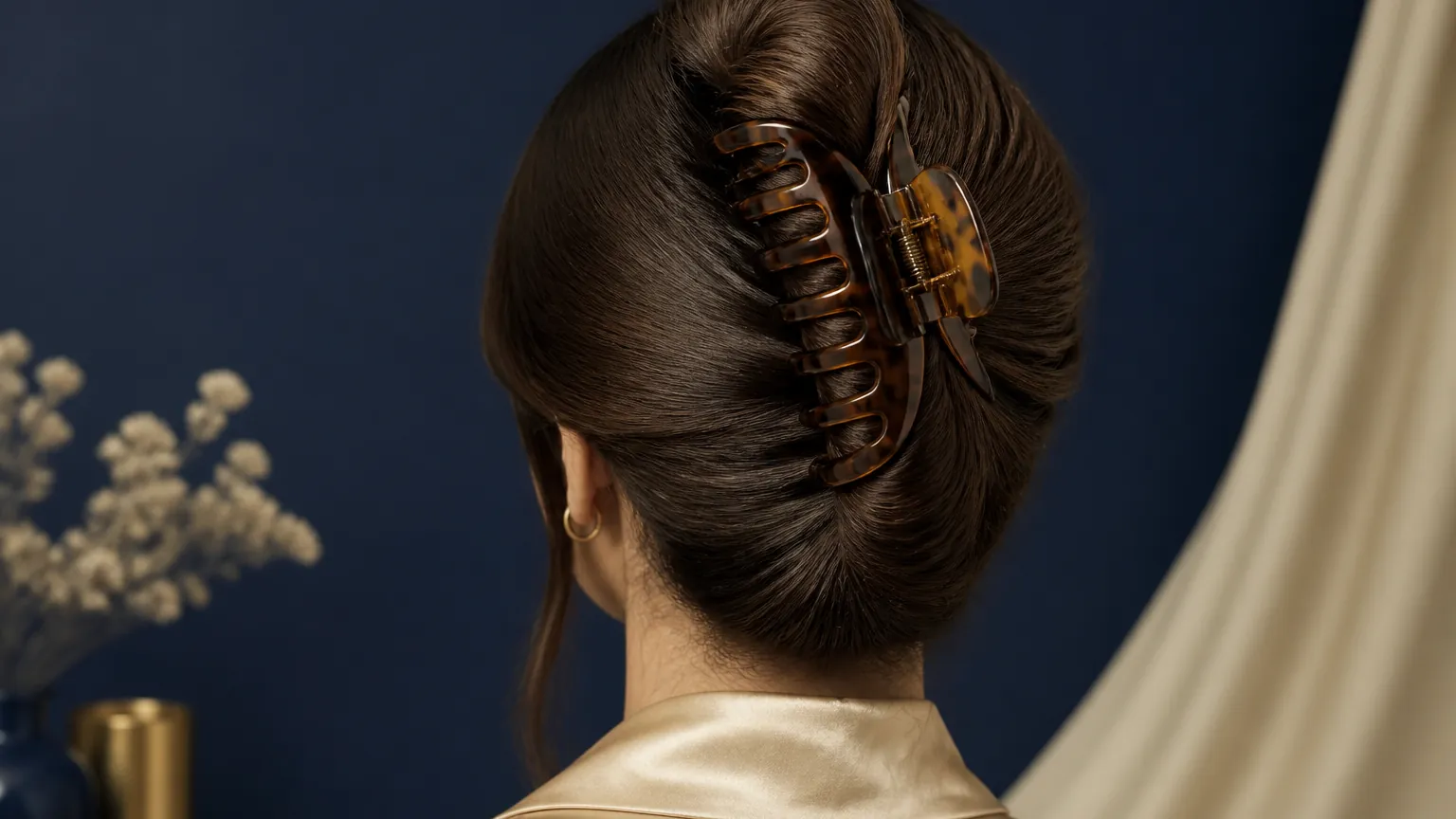
For thick or long hair, choose a claw clip by usable internal capacity, jaw opening, tooth depth, spring performance and structural reinforcement—not overall length alone. A 13 cm clip can still fail if its teeth are shallow or its arms flex open. The right design surrounds the folded hair bundle, captures base hair near the scalp and keeps the spring inside its working range.
Why “Extra Large” Clips Still Fail
Highly engaged Reddit threads from long-hair communities repeatedly report three failures: the clip cannot open far enough, the teeth sit on top of the twist instead of reaching through it, or the body and hinge break under load. These reports are useful demand signals, not standardized mechanical tests. They show why an extra-large label is incomplete without measurable construction details.
- Long body, shallow teeth: the clip covers the style but cannot anchor it.
- Wide jaw, weak spring: the hair fills the clip but slowly pushes the arms apart.
- Strong spring, thin arms: force concentrates near the hinge and the body cracks.
- Deep teeth, poor curvature: tooth tips press the scalp before the clip closes securely.
Measure Capacity, Not Just Clip Length
Start by building the intended style and measuring the thickest part of the folded hair bundle. Compare that bundle with the open jaw and the enclosed space behind the teeth. Length helps distribute the hold vertically, but depth and opening determine whether the clip can actually surround the hair. See the general claw clip size guide for common length ranges.
| Design variable | What it controls | Approval question |
|---|---|---|
| Usable internal capacity | How much folded hair fits behind the teeth | Does the jaw still close with working spring travel? |
| Tooth depth and curve | Whether the clip reaches through the twist to base hair | Do the teeth anchor without touching the scalp? |
| Jaw opening | How easily the style enters the clip | Can the user position it without forcing the arms? |
| Spring and hinge | Retention force and repeated-use durability | Does alignment remain stable after cycling? |
| Arm and tooth section | Resistance to flexing and breakage | Are stress areas reinforced without creating bulk? |
Tooth depth and curvature create the anchor
Deep, curved teeth can reach around a thick twist and capture base hair. Interlocking teeth or a short central row can add contact points, but more teeth are not helpful if the spacing crushes the bundle or the tips reach the scalp. The prototype must be assessed from the side as well as from the front: side geometry reveals whether the tooth arc follows the head.
Spring strength must match the complete structure
A stronger spring does not rescue a thin or brittle body. Spring torque, pin alignment, hinge wall thickness and material flexibility work as a system. Cellulose acetate offers a premium appearance and smooth finish, while quality engineered plastics can provide useful flexibility and lower weight. The correct choice depends on shape, section thickness and quality control, not the material name alone. Compare the tradeoffs in acetate vs plastic claw clips.
Reinforce stress zones without unnecessary weight
Cracks commonly begin at sharp internal corners, thin hinge walls or abrupt changes in section thickness. Rounded transitions and a balanced wall section distribute load more effectively. Decorative cutouts should not remove material from the hinge or tooth roots unless the prototype has passed repeated opening and loaded-wear tests.
Fit Test for Long or High-Volume Hair
- Create the exact French twist, folded ponytail or half-up style the clip is intended to hold.
- Confirm that several teeth pass through the outer twist and capture stable base hair on both sides.
- Check that the arms are not at their maximum spread and the spring is not visibly distorted.
- Wear the clip during normal walking and head movement, then inspect drift and pressure after 30 minutes and again after several hours.
- Open and close the sample repeatedly, comparing tooth alignment, spring position and cracks with an unused control sample.
Very long hair may hold better with a folded or split twist, a braid tucked under one large clip, or two medium clips sharing the load. Remove rigid clips before driving, vigorous exercise or reclining against a hard headrest; a secure fashion accessory is not designed as protective equipment.
What Brands Should Put in an “Extra-Strong” Specification
Avoid approving an extra-strong claim from hand feel alone. Define the target hair bundle and hairstyle, then keep a signed golden sample with dimensional and functional checkpoints. A useful range usually includes more than one capacity so customers do not have to overload a single universal design.
- Overall dimensions plus maximum jaw opening and usable internal depth.
- Tooth count, tooth length, curvature and minimum polished tip radius.
- Material grade, hinge pin material, spring specification and critical wall thickness.
- Repeated opening, loaded retention, drop and warm-storage screening methods.
- Approved packaging that prevents teeth from being bent during shipment.
WINCOME develops custom acetate claw clips and custom plastic claw clips in multiple sizes. Send a target hairstyle photo, desired dimensions and material direction through the custom sampling form to compare capacity before production.
Frequently Asked Questions
What claw clip size is best for thick, long hair?+
There is no universal length. Select a clip whose usable capacity surrounds the folded hair bundle, whose teeth reach stable base hair and whose jaw retains working spring travel.
Why does a large claw clip pop open?+
The hair bundle may exceed the usable capacity, the spring may be under-specified, or the body and hinge may flex under the load.
Are metal claw clips stronger for thick hair?+
Metal can be strong, but weight, tooth geometry, finish and spring design still determine comfort and hold. A well-engineered acetate or plastic clip can also perform well.
Do deeper teeth always hold more hair?+
They can improve anchoring, but the curve and tip position must match the head. Teeth that are too deep or poorly curved may press the scalp.
How should brands test an extra-strong claw clip?+
Test loaded retention on the target hairstyles, repeat opening cycles, inspect hinge alignment and cracks, and compare results with an unused approved sample.
Keep Reading
Related Articles
Start Your Project
Ready to Talk to a Factory Directly?
Free design mockup and factory-direct quote within 24 hours. Production MOQs vary by category; samples and in-stock items may be available below the custom minimum.